Cranberry Powder Extract is not one uniform ingredient. It may be made from whole fruit, juice solids, or concentrated extract, and each route leaves a different chemical and sensory fingerprint. A bright-red powder that disperses quickly in water can be useful in a drink mix; a darker, tart powder may suit capsules or baked blends better. Yet color and taste alone cannot confirm active-compound levels. Buyers should check the ingredient source, processing method, carrier ingredients, and assay used to measure proanthocyanidins (PACs).
Industry comparisons need careful reading. USDA’s National Agricultural Statistics Service publishes annual cranberry production data, offering context on the fruit supply, but crop volume does not prove extract strength or finished-product quality. For that, technical specifications and batch testing matter. Amy B. Howell, a Rutgers cranberry researcher, has studied cranberry proanthocyanidins and their biological activity. A practical takeaway from her research is that cranberry preparations should not be treated as interchangeable. Small label details matter.
This guide compares the main types of Cranberry Powder Extract: whole-fruit powder, cranberry juice powder, and standardized cranberry extract powder. It also considers PAC standardization, drying methods, solubility, and intended use. One caution: “standardized” can sound definitive, but results depend on the assay and specification stated by the supplier. A useful comparison therefore asks not only how much cranberry a product contains, but what was measured, how it was measured, and whether the test applies to the finished batch.
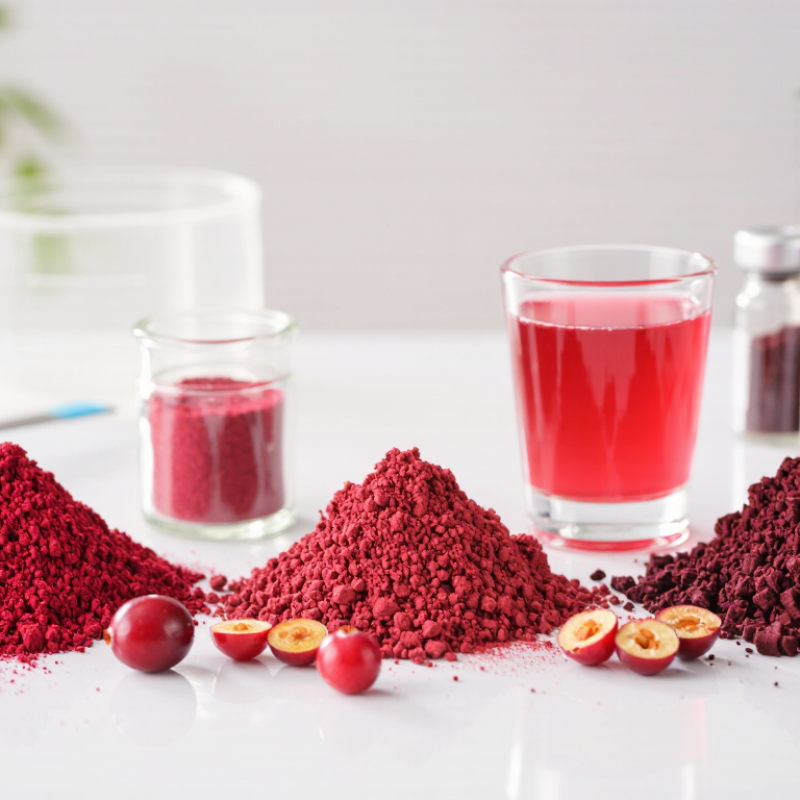
Cranberry powders are not interchangeable, even when their labels use similar language. A useful starting point is the material used: whole fruit, juice, or concentrated extract. Whole-fruit powder usually comes from dried berries milled into a fine, tart ingredient. Depending on processing, it may retain portions of the skin, pulp, and seeds. That matters. Its color can range from deep red to muted brown, and its flavor often stays noticeably sharp.
Juice powder starts with cranberry juice, which is concentrated and dried. The resulting powder may have less fiber than whole-fruit powder because much of the solid fruit material is removed before drying. Some formulations also contain a carrier ingredient to help the powder flow or dissolve. Check the full ingredient list. A vivid color alone does not reveal how much cranberry is present.
Extract powder is made by concentrating selected cranberry components, rather than simply drying the whole berry or juice. It may be standardized to a stated level of particular compounds, but the extraction method and specifications can differ. The categories are useful, though real processing can blur their edges. When comparing powders, look for the source material, ingredient list, and clear composition details; “cranberry powder” by itself leaves questions unanswered.
Whole-fruit cranberry powder is made by drying and grinding berries. Unlike extracts designed to concentrate selected compounds, it may retain some native fiber alongside naturally occurring polyphenols. The amounts can vary with berry source and processing. Color alone is not proof of composition.
Fiber can add body to oatmeal, yogurt, or a smoothie. A spoonful may leave fine flecks and a thicker texture. Cranberries contain polyphenols, including anthocyanins, but drying can affect their levels. “Whole fruit” does not guarantee a fixed dose or identical benefits across products. Check ingredient and nutrition details, and look for clear testing information when available.
Cranberry juice powder is made from concentrated juice that has been dried into a fine ingredient. Its cranberry portion is often described as juice solids. These solids contain the material left after much of the water is removed, including naturally occurring sugars, acids, color, and other juice components. The exact profile depends on the fruit and processing method. A scoop may look bright red, but color alone cannot show how much cranberry material it contains.
Many juice powders also include carriers, such as maltodextrin or gum arabic. These ingredients can help the liquid feed dry evenly and make the finished powder easier to handle. They may also reduce clumping during storage. Check the ingredient list: a powder with a carrier is not necessarily pure juice solids, and carrier amounts can vary. That distinction matters.
For a closer comparison, look at the stated juice-solids content, the full ingredient list, and any available specification sheet. Ask how the powder is intended to dissolve and whether it suits your recipe. A small test batch can reveal practical details, like sediment or a tart finish. Labels are useful, but they do not tell the whole story. I would not judge a powder by its color or serving size alone.
Cranberry juice solids provide the fruit-derived portion of the powder; carriers can help with drying and powder handling. This chart marks common functions of carrier ingredient groups, not their amounts in a recipe. Functionality varies by ingredient grade, and there is no single standard carrier ratio for cranberry juice powder.
What Are the Top Types of Cranberry Powder Extract?
Standardized cranberry extracts are often described by total proanthocyanidins (PACs), but total PAC content does not reveal the share of A-type linkages. These distinctive bonds are commonly discussed in cranberry research. Gu et al. (2002), in the Journal of Agricultural and Food Chemistry, characterized A-type linkages in cranberry proanthocyanidins. Useful distinction. A powder labeled “standardized” should state its PAC percentage, test method, and reporting basis, such as dry weight.
For quality checks, AOAC Official Method 2012.24 describes a DMAC approach for measuring PACs in cranberry products. DMAC results are method-dependent: the reference standard and sample preparation can affect reported values. More importantly, a total-PAC result does not independently quantify A-type PACs. Buyers comparing supplier certificates of analysis should check that the same assay and calculation basis were used. A precise number can still leave questions.
Tips: Ask for a batch-specific certificate of analysis, the named assay, and its reference standard. If A-type content matters, request a validated method that reports it separately. Powder color and fine texture may help assess consistency, but neither proves PAC concentration. I would not compare percentages from different methods as if they were interchangeable.
| Extract type | Typical composition and format | PAC standardization | A-type PAC relevance | Useful assay approach | Key interpretation note |
|---|---|---|---|---|---|
| Whole cranberry fruit powder | Dried, milled fruit; may contain fruit solids, fiber, sugars, organic acids, pigments, and naturally occurring polyphenols. | Often characterized by fruit-derived constituents rather than a single, high PAC specification. | PACs may be present, but their amount and profile depend on the fruit material and processing. | DMAC colorimetry can estimate total PACs when the method is validated for the powder matrix; chromatographic profiling can provide additional detail. | A whole-fruit powder is not equivalent to a PAC-enriched extract. Matrix effects and extraction conditions can affect results. |
| Cranberry juice powder | Dehydrated juice or juice concentrate, commonly produced with a carrier to support drying and powder handling. | May be described by juice solids or other compositional measures; PAC content should be confirmed rather than inferred from the word “cranberry.” | PACs can be present, but juice processing and clarification may alter the amount and profile retained. | A validated DMAC method is suitable for total-PAC screening; use chromatographic methods when a more detailed polyphenol profile is needed. | Report the sample basis and account for carriers and moisture when comparing results across powders. |
| Polyphenol-rich cranberry extract | An extract concentrated in cranberry polyphenols; the precise profile depends on the starting material and extraction process. | May be standardized to total polyphenols, PACs, or another declared marker. The specification should name the assay used. | Can contain A-type and B-type PAC structures; a total-PAC result does not establish the proportion of A-type structures. | Use DMAC for a method-defined total-PAC value and chromatographic profiling for selected PACs and other polyphenols. | “Polyphenol-rich” is not a quantitative PAC claim unless a value, method, and reporting basis are provided. |
| PAC-standardized cranberry extract | A cranberry extract with a stated PAC content, commonly supplied as a dry powder. | A meaningful specification states the PAC value together with the assay, reference standard, sample preparation, and whether results are reported on an as-is or dry-weight basis. | Standardization to total PACs does not by itself quantify A-type linkages or prove a particular A-type PAC profile. | DMAC colorimetry is widely used for PAC estimation. LC-based methods can complement it by profiling individual or selected compounds. | PAC percentages obtained using different methods or standards may not be directly comparable. |
| A-type PAC-profiled cranberry extract | An extract assessed for PAC structural features, including A-type interflavan linkages, in addition to or instead of a total-PAC claim. | Structural profile and total-PAC content are separate measurements and should be reported separately. | A-type PACs have an additional ether linkage compared with the more common B-type interflavan linkage; structural assignment requires an appropriate analytical approach. | LC-MS can support PAC profiling; reference compounds and, where needed, complementary structural techniques help strengthen identification. DMAC alone does not distinguish A-type from B-type PACs. | Ask for the analytes reported, identification criteria, reference materials, and validation details before interpreting an A-type claim. |
Assay note: DMAC (4-dimethylaminocinnamaldehyde) is a colorimetric method used to estimate proanthocyanidins (PACs). Results depend on the method conditions and reference standard. Because DMAC does not establish PAC linkage type, it should not be used alone to claim an A-type PAC concentration. Always compare results generated with the same method and reporting basis.
Cranberry powder extracts vary in how they are made and measured. Whole-fruit powders retain more of the berry’s natural mix, while concentrated extracts aim to deliver more proanthocyanidins, or PACs, in less powder. Juice powders are another option, but their PAC content may differ widely. A scoop can look similar. Its active content may not be.
The 36 mg PAC figure is a useful comparison point because clinical studies have often examined daily intakes around this level. It is not a universal guarantee, and results depend on the study, product, and testing method. Check whether a label states PACs per serving, rather than only listing cranberry extract weight. Those numbers are not interchangeable. PAC testing methods can also produce different results, so transparent methods and independent analysis matter. Look for a clearly stated daily serving and a reported PAC amount near the studied benchmark. The numbers still leave room for doubt. Even careful labels cannot promise the same outcome for every person, and cranberry supplements are not a substitute for medical care.
It usually means the extract is tested for a stated amount of proanthocyanidins, or PACs. Check the percentage, test method, and reporting basis.
No. Total PAC results do not separately measure A-type PACs. Ask for a validated test that reports them separately.
Look for batch-specific results, the named assay, its reference standard, and the calculation basis. Details matter.
Not reliably. Methods and reference standards can change reported values. Similar numbers may not mean similar results.
No. Color and fine texture may help you notice consistency, but they cannot confirm PAC concentration. A neat-looking powder proves little.
Whole-fruit powder retains more of the berry’s natural mix. Concentrated extracts aim to provide more PACs in less powder. Juice powders can vary widely.
It is a comparison point because some clinical studies examined daily intakes around that amount. It is not a universal guarantee.
Check the stated PAC amount per serving, daily serving size, and testing method. Extract weight alone does not tell you PAC content.
No. Outcomes can depend on the study, product, testing method, and person. Labels leave some uncertainty, and supplements are not a substitute for medical care.
Cranberry powders are generally classified as whole-fruit powders, juice powders, or concentrated extracts, and the differences affect their composition and intended use. Whole-fruit cranberry powder retains more of the fruit’s native fiber along with a range of polyphenols. Juice powder is made from cranberry juice solids and may include carrier ingredients to help with drying, handling, and blending, so its composition can differ from that of the original fruit.
Standardized Cranberry Powder Extract is distinguished by its measured content of A-type proanthocyanidins, or PACs. Because testing methods can vary, assay results are important when comparing products; powder weight alone does not show how much PAC is present. The 36 mg PAC figure used in some clinical studies is a useful reference point, but comparisons should account for how PACs were measured and reported. Understanding these categories and measurements helps readers evaluate cranberry powders more accurately.

ShineHerb